
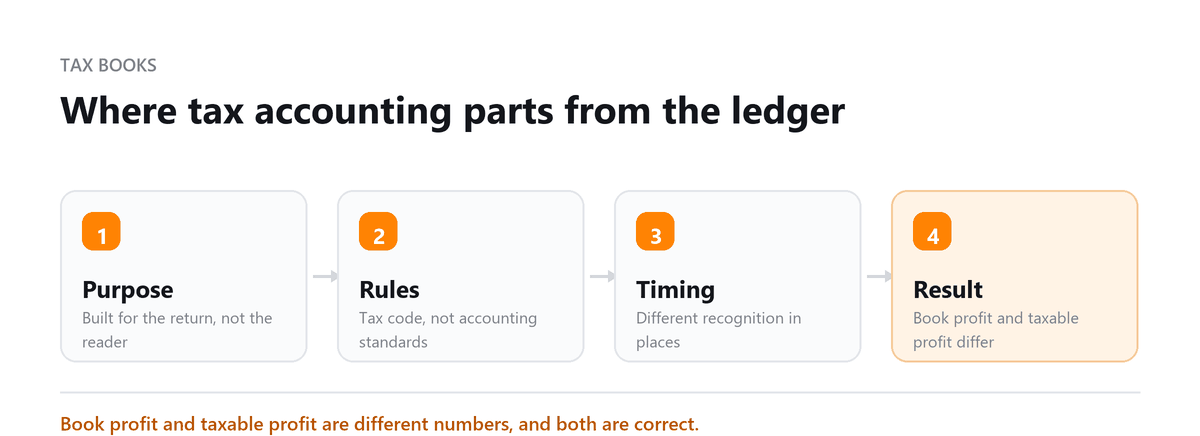
Many business owners assume their financial statements and their tax return tell the same story. Then they compare the two and find a profit figure on the income statement that looks nothing like the taxable income on the return. Equipment was written off all at once for taxes but spread over years in the books. Half of client meals didn't count. A customer deposit was taxed in a different year than it was earned. Neither report is wrong. They're just following different rules.
That's where tax accounting comes in. Tax accounting is the process of recording and reporting financial activity according to tax law rather than accounting standards.
It determines taxable income, applies deductions and credits, prepares returns, and plans ahead so the business pays what it owes without paying more than necessary. For individuals, businesses, partnerships, and nonprofits alike, it's what turns bookkeeping records into accurate, defensible tax filings.
Expert Perspective
The most useful thing a business owner can understand about tax accounting is that book income and taxable income are supposed to be different. When depreciation, meals, deferred revenue, and owner compensation are handled correctly in the books, the tax return practically builds itself, and the owner can plan decisions like equipment purchases or an S corporation election before year-end instead of discovering the tax effect in April.
Ankit Sarawagi, CPA, CA, MBA · LinkedInWhat is Tax Accounting?
Tax accounting is a specialized branch of accounting focused on minimizing tax obligations while maintaining compliance with IRS rules and applicable law. A tax accountant examines a client's financial records, calculates tax duties owed, prepares and files returns, and develops strategic planning approaches to legally reduce the overall tax burden. Unlike financial accounting which aims at accurate historical reporting tax accounting is forward-looking: every decision is evaluated through the lens of its tax consequence.
Types of Tax Accounting
Individual Tax Accounting
Individual tax accounting covers personal income tax returns, deductions, credits, and estimated tax payments. Freelancers, salaried employees, and investors all have distinct tax profiles that require different strategies. An individual tax accountant identifies deductions (home office, student loan interest, charitable contributions), credits (child tax credit, education credits), and ensures estimated quarterly payments are calibrated to avoid underpayment penalties.
Corporate Tax Accounting
Corporate tax accounting handles business entity compliance. C-corporations file Form 1120; S-corporations file Form 1120-S; partnerships file Form 1065. Corporate tax work involves identifying deductions for business expenses, applying depreciation rules (MACRS, Section 179, bonus depreciation), claiming R&D tax credits, and managing carryforward losses. The entity structure itself has major tax implications, choosing between C-corp, S-corp, and LLC taxation is a foundational tax accounting decision.
International Tax Accounting
International tax accounting serves businesses and individuals with multi-country operations or income. Key areas include transfer pricing (ensuring intercompany transactions are at arm's length), foreign tax credits, FATCA compliance for U.S. persons with foreign financial accounts, and navigating tax treaties to prevent double taxation. Any business earning revenue internationally or employing foreign workers needs specialized international tax guidance.
Estate and Gift Tax Accounting
Estate and gift tax accounting involves planning for the tax-efficient transfer of wealth. The federal estate tax applies to estates above the applicable exclusion amount; the gift tax applies to transfers above the annual exclusion amount. Strategic planning, including irrevocable trusts, annual gifting programs, and family limited partnerships, reduces estate tax exposure and ensures wealth transfers according to the client's intentions rather than default tax law.
Tax Accounting Examples
- Freelancer home office deduction: allocate a dedicated workspace, calculate square footage as a percentage of total home square footage, deduct that proportion of rent or mortgage interest, utilities, and internet costs. Even a 10% allocation on a $2,000/month rent generates $2,400 annually in deductions.
- Small business structure optimization: a sole proprietor earning $150,000 net income pays self-employment tax on the full amount. An S-corp election with a $75,000 reasonable salary subjects only the salary to payroll taxes, saving potentially $10,000+ annually in SE tax.
- Depreciation strategy: rather than depreciating a $50,000 equipment purchase over five years, use the Section 179 election or bonus depreciation to deduct the full cost in the year of purchase, front-loading the tax benefit when it is most valuable.
- Real estate investor: residential rental property depreciates over 27.5 years under straight-line MACRS. A $275,000 property generates $10,000 per year in depreciation expense that offsets taxable rental income, a non-cash deduction that substantially reduces effective tax rates on rental portfolios.
Tax Accounting vs Financial Accounting
| Factor | Tax Accounting | Financial Accounting |
|---|---|---|
| Primary goal | Minimize tax liability (legally) | Accurate financial reporting |
| Standards used | IRS tax codes, IRC | GAAP or IFRS |
| Time focus | Future planning + compliance | Historical accuracy |
| Audience | IRS, tax authorities | Investors, lenders, management |
| Methods | Cash or accrual (per IRS rules) | Accrual (GAAP standard) |
Reasons to Learn Tax Accounting
Understanding tax accounting, even at a foundational level, pays concrete dividends. Business owners who grasp the basics identify deduction opportunities their software misses, avoid costly compliance errors, and have more productive conversations with their CPAs. The potential savings through legal deduction optimization frequently exceed the cost of learning. Beyond the financial dimension, advance tax planning reduces the stress of surprise tax bills and IRS correspondence. For finance professionals, tax accounting is a high-demand career path: enrolled agents, CPAs, and tax specialists are consistently ranked among the most in-demand accounting professionals.
How to Become a Tax Preparer
A bachelor's degree in accounting is the preferred educational foundation, though not legally required for basic tax preparation. The IRS Annual Filing Season Program (AFSP) is an accessible entry point, completers receive limited representation rights. The Enrolled Agent (EA) designation, earned by passing the three-part Special Enrollment Examination, confers full IRS representation rights and is recognized as a mark of tax expertise. The CPA license is the highest credential for complex returns, estate planning, and corporate tax work.
Crucially, continuing education is not optional: tax laws change every legislative cycle, and practitioners must maintain current knowledge.
Why Companies Hire Tax Accounting Specialists
Tax software handles data entry and arithmetic, but it does not replace professional judgment. Companies hire tax accounting specialists for expertise that goes beyond what software can provide: knowledge of obscure provisions, industry-specific regulations, and strategic planning that requires understanding the business. The cost reduction achieved through strategic planning, proper entity structure, timing of income and deductions, credits that software misses, typically exceeds the specialist's fee many times over.
Specialists also provide compliance assurance (reducing audit risk), financial decision support (evaluating the tax impact of major transactions), and risk mitigation against penalties.
How Profitjets Helps with Tax Accounting
Profitjets provides tax accounting support for individuals, small businesses, startups, and corporations, covering federal and state tax preparation, tax planning, IRS compliance, multi-state filings, and tax notice or audit assistance.
Clients submit their financial documents through a secure online process, after which the tax team prepares the returns, completes a review with the client, and handles filing and confirmation. Profitjets also offers flexible service arrangements rather than requiring a long-term contract, with dedicated tax professionals available throughout the process.
More than 500 businesses trust Profitjets for tax services, according to the company's current tax services page. Profitjets also publicly reports a 98% client retention rate across its services.
I most often see clients lose money because they treat tax preparation as a once-a-year task instead of planning throughout the year. The single change that can make the biggest difference is reviewing income, expenses, deductions, and estimated taxes before year-end, while there is still time to make informed tax decisions.
Conclusion
Tax accounting is not just a compliance function, it is a profit center when done right. The difference between a business that overpays taxes and one that pays exactly what the law requires is almost always the quality of tax planning, not the tax rates themselves. Whether you are a freelancer optimizing deductions, a small business evaluating entity structure, or a growing company with multi-state nexus, working with a qualified tax accountant produces returns that far exceed the investment.
Book a free consultation and we will handle the books and the return.
FAQs
What is the difference between a tax accountant and a CPA?
All CPAs can do tax accounting, but not all tax accountants are CPAs. A CPA is a licensed professional who has passed the Uniform CPA Exam and meets state licensing requirements, they can also represent clients before the IRS. Tax preparers without CPA credentials can prepare returns but have limited IRS representation rights unless they are an Enrolled Agent.
How is tax accounting different from bookkeeping?
Bookkeeping records daily financial transactions. Tax accounting uses those records to determine tax liability, identify deductions, plan for future tax obligations, and ensure compliance with IRS rules. Bookkeeping is the foundation; tax accounting is the strategic application of that data to minimize what you legally owe.
When should a small business hire a tax accountant rather than using software?
Software handles straightforward situations well. Hire a tax accountant when: you have multiple income sources or entities, you are considering an S-corp election, you have employees, you own real estate, you received a significant capital gain, or you are being audited. The fee typically pays for itself multiple times over.
What records do I need to give my tax accountant?
Provide: all income statements (1099s, K-1s, W-2s), bank and credit card statements, expense receipts by category, payroll records, asset purchase documentation, prior year tax returns, and any IRS correspondence. The more organized your records, the lower your accounting fee.
How far in advance should I do tax planning?
Year-round, not just in March and April. Effective tax planning identifies deductions to accelerate or defer, timing of income recognition, entity structure decisions, and retirement contribution strategies, most of which must be acted on before December 31. By the time you file, the opportunities for the prior year are gone.

Written by
Ankit Sarawagi, CPA, CA, MBA
Ankit leads the finance team at Profitjets, where he has worked with 500+ businesses across the US on bookkeeping, tax and CFO-level strategy. He writes about the habits that keep small business books accurate all year. Connect on LinkedIn
Free consultation
Want Both Sets Reconciled?
Book a free consultation and we will handle the books and the return.