
Most small business owners make decisions based on figures that are weeks old. The books for a particular month are closed by the time one starts looking at the next, reports come out after that and by the time they have been read over, the payrolls, rents and supplier bills for the coming month are due.
Real-time reporting and accounting close much of that gap. With banks feeds, payment processors, invoicing and point-of-sale systems that send transactions into accounting software as soon as they occur.
Rules sort most of them out automatically and dashboards that show cash, receivables and month-to-date profits without the need to compile anything manually, owners can view where the business is on a given day and take corrective measures in good time.
"Real time" is a limited concept, however. Bank feeds update on a daily basis rather than in real time, automated categorization can come with errors and accruals and depreciation are still manually entered at month-end. As much as fast numbers can give insight, they have to be accurate to be of any use and the businesses that reap the most benefit from real-time accounting are those that combine it with regular reviews and reconciliations.
Expert Quote
The old model was: close the books in 10 days, generate reports in week 2, make decisions in week 3. By then you're reacting to a month-old picture. Real-time accounting means the picture updates every day and the decisions happen when they still matter.
Ankit Sagatani, MBA, B.Com · LinkedInWhat is Real-Time Reporting?
Real-time reporting refers to systems that collect financial data from multiple sources and process that information immediately making it available for review without delay. Traditional reporting models rely on month-end manual compilation: transactions recorded throughout the month are reconciled, categorized, and summarized after the fact. By the time the report is reviewed, the data is weeks old. Real-time reporting replaces this lag with continuously updated dashboards that reflect the current financial position of the business at any moment.
How Real-Time Reporting Works
Data collection begins at the source: point-of-sale systems, bank feeds, invoicing platforms, and payment processors all feed transaction data directly into the accounting system as each event occurs. Automated rules categorize transactions by account, department, or project. The categorized data populates live dashboards visible to stakeholders with appropriate role-based permissions, a department manager sees their budget vs. actuals; the CFO sees the consolidated P&L and cash position. No manual data transfer, no end-of-month reconciliation scramble.
Benefits of Real-Time Reporting
Improved Decision-Making
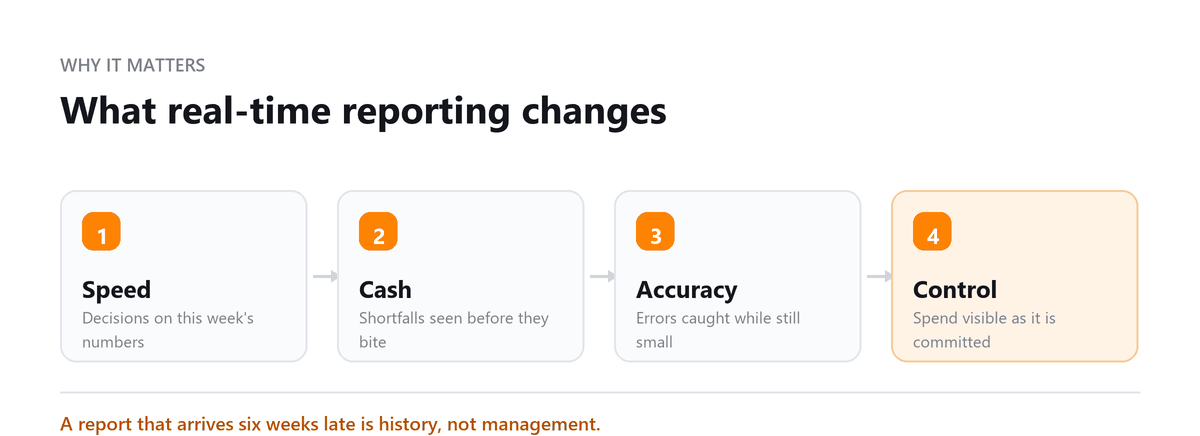
Current data enables faster, more confident decisions. A purchasing manager deciding whether to place a large order needs to know the current cash position, not last month's. A CEO evaluating a new hire needs current payroll costs, not a month-end estimate. Real-time reporting closes the gap between when decisions are made and when the financial data informing those decisions was captured.
Enhanced Transparency
When all stakeholders access the same live financial data, information asymmetry collapses. Finance teams are not the gatekeepers of financial truth, department heads, operations managers, and leadership all work from the same current picture. This alignment reduces friction, improves accountability, and enables better cross-functional coordination.
Reduced Manual Labor
Automated data flows from bank feeds, payment systems, and invoicing tools eliminate hours of manual spreadsheet work each month. Bookkeepers who previously spent days on data entry shift their time to exception review, reconciliation of edge cases, and advisory support, higher-value work that cannot be automated.
Optimized Business Goals
Continuous performance monitoring against budget targets means variances are caught when they are still small and correctable, not at month-end when the opportunity for intervention has passed. A sales team trending 15% below target in week two has time to course-correct; a sales team that learns this in week five does not.
What is Real-Time Accounting?
Real-time accounting extends real-time principles across all financial transactions, not just reporting outputs. Every invoice issued, payment received, and expense recorded updates the financial statements immediately. The result is a continuously current view of the P&L, balance sheet, and cash position. Platforms like QuickBooks Online and Xero achieve this through live bank feeds, automated invoice matching, and cloud-based processing that updates balances without batch processing delays.
Benefits of Real-Time Accounting
Immediate Financial Insights
A business owner with real-time accounting can answer three critical questions at any moment: What is my current cash balance? What does my P&L look like month-to-date? What invoices are outstanding and when do they come due? Without real-time accounting, answering these questions requires pulling data from multiple sources and manually compiling it, a process that introduces both delay and error risk.
Improved Cash Flow Management
Cash flow problems are almost never sudden, they develop over weeks, with warning signs visible in advance to anyone who is looking at current data. Real-time accounting surfaces those warning signs while there is still time to act: accelerate collections, extend a payment, or draw on a credit line. Businesses relying on month-end reports see the problem after it has already arrived.
Enhanced Compliance
Continuous record-keeping means books are audit-ready at all times, not just at year-end. Expense receipts are matched to transactions as they occur. Bank reconciliation happens weekly or daily rather than once a month. When an audit or due diligence request arrives, the documentation is already organized, not reconstructed under pressure.
How Real-Time Reporting and Accounting Transforms Business
The compounding effect of real-time financial visibility is a fundamentally different operating posture. Resource allocation decisions are based on current data rather than historical summaries. Operational costs are optimized continuously rather than reviewed quarterly. Strategy is data-driven rather than intuition-driven. Businesses that make this shift consistently report better cash management, fewer compliance surprises, and higher confidence in their financial decisions.
Profitjets as Your Partner
Profitjets implements real-time accounting using platforms such as QuickBooks, Xero, NetSuite, and Zoho Books. The process starts with a discovery call to understand the client's current accounting setup, followed by account and chart-of-accounts setup, transaction recording, bank and credit-card reconciliation, and monthly financial reporting.
Once the system is running, a dedicated bookkeeping professional maintains the records and provides ongoing reporting and support.
Profitjets reports that some clients' books have gone from taking 15 hours a month to just 15 minutes to review after the bookkeeping process is streamlined. The company also says its bookkeeping services can cost up to 70% less than an in-house hire.
:The biggest result I’ve seen is how quickly a client can move from waiting for month-end numbers to actually using current financial information to make decisions. Once their transactions, reconciliations, and reporting were brought into a real-time workflow, they could spot cash-flow changes earlier and respond before small issues became bigger problems.
Conclusion
Real-time reporting and accounting are not luxury features reserved for large enterprises, they are accessible to any business using modern cloud accounting software, and they pay for themselves through time savings, better decisions, and avoided cash flow crises. The question is not whether your business can afford real-time accounting. It is whether you can afford to keep making decisions on last month's numbers.
Book a free consultation and we will get them arriving in time to act on.
FAQs
What is the biggest benefit of real-time accounting for a small business?
Instant cash flow visibility. Instead of finding out in week two that last month was a cash shortfall, you see the problem developing in real time, while you still have time to accelerate collections, defer payments, or draw on a credit line.
Is real-time accounting affordable for small businesses?
Yes, tools like QuickBooks Online and Xero start at $25 to $38/month and provide real-time bank feeds, automated categorization, and live dashboards. Outsourced bookkeeping services add human review at a fraction of an in-house bookkeeper's cost.
Can real-time accounting work for freelancers?
Absolutely. A freelancer with even one bank account connected to accounting software gets real-time visibility into income, expenses, estimated quarterly taxes, and invoices outstanding, with minimal setup effort.
How does real-time accounting improve tax filing?
Continuously updated, categorized records mean your books are complete at December 31, not in March. Year-end tax prep becomes a review exercise rather than a reconstruction project, and your CPA spends less time (and charges less) on cleanup.
How long does it take to implement real-time accounting?
Most businesses can connect bank feeds and activate real-time reporting in 7 to 14 days with professional assistance. The setup involves connecting bank accounts, mapping the chart of accounts, and establishing categorization rules. The investment pays back in the first month of time saved.

Written by
Ankit Sagatani, MBA, B.Com
Ankit works with business owners across the US on industry-specific bookkeeping, from real estate to construction and retail. He writes about what each trade's books actually need. Connect on LinkedIn Connect on LinkedIn
Free consultation
Waiting Weeks for Your Numbers?
Book a free consultation and we will get them arriving in time to act on.