
This single figure does more work than almost any other on a personal return. It is not what you earned and it is not what you are taxed on, but it decides a great deal of what happens in between.
A large number of reliefs, restrictions and thresholds are measured against it rather than against total income, which means something that reduces it can be worth considerably more than its face value suggests.
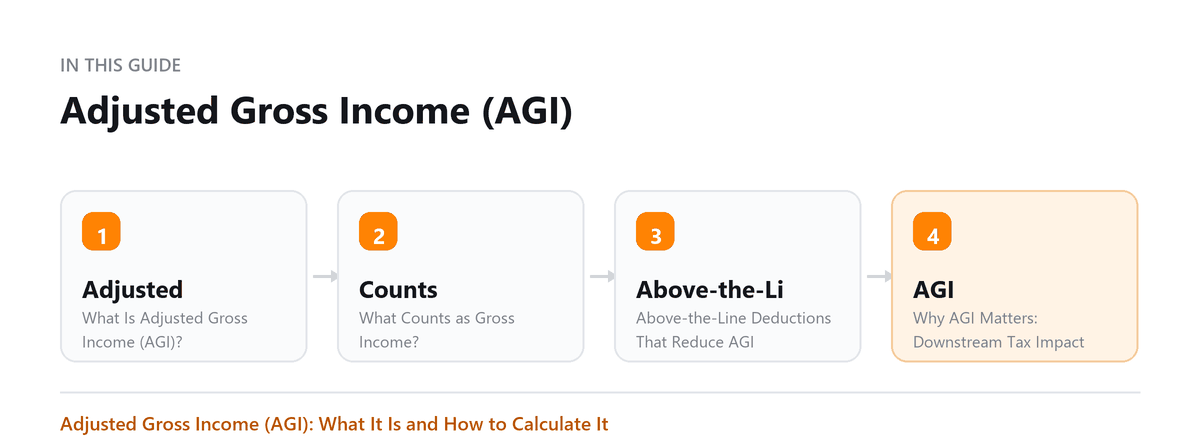
This covers what counts as gross income, the deductions that reduce it before anything else is calculated, why it matters so much downstream, how it differs from the modified figure some provisions use, and how to work it out.
What Is Adjusted Gross Income (AGI)?
Adjusted Gross Income (AGI) is your total gross income minus specific above-the-line deductions. The IRS uses your AGI as the starting point to calculate your taxable income, and it determines your eligibility for dozens of credits and deductions.
A surprising number of other provisions are measured against this figure rather than against total income, so something that reduces it can be worth considerably more than its face value. That is why the planning conversation belongs before the year closes rather than at the return.
Anu Gupta, CA, EA, B.Tech · LinkedInWhat Counts as Gross Income?
Gross income is all income you receive before any deductions. This includes:
- Wages, salaries, and tips (W-2 income)
- Self-employment income (Schedule C net profit)
- Interest and dividend income
- Capital gains from investments
- Rental income
- Alimony received (for divorces finalized before January 1, 2019)
- Unemployment compensation
- Taxable Social Security benefits
- Business income from partnerships, S-corps, and trusts
Above-the-Line Deductions That Reduce AGI
These deductions are subtracted from gross income to arrive at AGI, you can claim them whether or not you itemize:
| Deduction | Details |
|---|---|
| Student loan interest | Up to $2,500; phases out at higher incomes |
| Self-employed health insurance | 100% of premiums paid for yourself and family |
| Half of self-employment tax | Deduct the employer-equivalent portion of SE tax |
| Traditional IRA contributions | Up to $7,000 ($8,000 if 50+) for 2025, subject to income limits if covered by workplace plan |
| Alimony paid (pre-2019 divorce) | Only for divorce agreements executed before Jan 1, 2019 |
| Educator expenses | Up to $300 ($600 MFJ if both are educators) |
| HSA contributions | Up to $4,300 individual / $8,550 family (2025) |
| Moving expenses | Only for active-duty military members |
| Penalty on early savings withdrawal | Penalty paid on early CD or savings account withdrawal |
Why AGI Matters: Downstream Tax Impact
Your AGI is used to calculate or limit many other tax items:
| Tax Item | How AGI Affects It |
|---|---|
| Standard deduction | AGI used as reference baseline for phase-outs |
| Earned Income Tax Credit (EITC) | Phase-out starts at certain AGI thresholds by filing status |
| IRA deductibility | Phase-out begins if you have a workplace plan |
| SALT deduction | Subject to $10,000 cap regardless of AGI |
| Medical expense deduction | Only expenses > 7.5% of AGI are deductible |
| Charitable contribution limits | Generally capped at 60% of AGI for cash donations |
| Child and Dependent Care Credit | Reduced as AGI rises |
MAGI vs AGI: Key Differences
Modified Adjusted Gross Income (MAGI) adds back certain deductions to AGI. MAGI is used for:
- Roth IRA contribution eligibility (2025: phase-out $146,000-$161,000 single; $230,000-$240,000 MFJ)
- IRMAA (Medicare Part B and D surcharges), based on MAGI from 2 years prior
- ACA marketplace premium tax credits
- Student loan interest deduction phase-out
- Child tax credit and EITC calculations
Pro Tip: MAGI adds back items like IRA deductions, student loan interest, and foreign earned income exclusion. For most taxpayers, MAGI equals or is slightly higher than AGI.
How to Calculate Your AGI Step by Step
- Total all income sources (wages, self-employment, interest, dividends, capital gains, etc.)
- Add them to get Gross Income
- Subtract each above-the-line deduction you qualify for
- The result is your AGI, reported on Form 1040 Line 11
- From AGI, subtract the standard deduction or itemized deductions to get Taxable Income
Book a free consultation and we will take the return off your desk.
Frequently Asked Questions
Is AGI the same as taxable income?
No. AGI is before the standard or itemized deduction. Taxable income = AGI minus the standard deduction (or itemized deductions) minus qualified business income deduction if applicable.
Where do I find my AGI on my tax return?
Line 11 of Form 1040 for tax years 2020 onward. The IRS also uses your prior-year AGI as an e-file PIN.
Does AGI affect my state taxes?
Most states start with federal AGI and then apply state-specific additions and subtractions. Some states use a different starting point.
Can I reduce my AGI?
Yes, contribute to a traditional IRA or 401(k), open an HSA, deduct SE health insurance, and capture all eligible above-the-line deductions before April 15.
Why does this single figure matter so much?
Because a large number of other provisions are measured against it rather than against your total income. Eligibility for various reliefs, the point at which some deductions start to be restricted, and several thresholds all key off it, so a change here can affect several things at once. That is also why something that reduces it can be worth more than its face value suggests.

Written by
Anu Gupta, CA, EA, B.Tech
Anu works with US businesses on tax and entity questions at Profitjets, from choosing a structure to the filings that follow it. She writes about the decisions owners make once and then live with for years. Connect on LinkedIn
Free consultation
Want the Filing Handled?
Book a free consultation and we will take the return off your desk.