
Most business owners know they have a tax deadline on April 15, but not so many know that their S corporation or partnership return was due a month ago, or that they didn't just miss a 1099-MISC deadline, or that estimated taxes are due four times a year on dates that don't follow a regular pattern.
By the time you realize you missed a deadline, it's too late to do anything about it, and all you can do is figure out how much the IRS will make you pay for it.
The penalties for missing the deadlines are significant and can add up quickly. For example, you could be penalized 5 percent per month (up to a maximum of 25 percent) for filing an income tax return than the deadline.
The same type of penalty applies to a partnership or S corporation tax return, but for each individual who owns more than 1 percent of the business, and for each month that the return is late.
Payroll tax deposits for businesses that are submitted after the due date and without permission for an extension of time to pay are penalized up to 15 percent. And, you'll continue to be charged interest on any amount of tax that remains due.
This guide covers 2026 federal deadlines for business and individual tax returns, extensions, quarterly estimated taxes, payroll taxes, and information returns, along with the penalties for missing them and a simple system to stay organized.
The solution is to know the tax deadlines for your type of business, to put the due dates on a calendar, to give yourself enough time to prepare and file the necessary paperwork, and to be aware of the types of extensions of time that apply to your situation. Here's what you need to know about the federal tax deadlines in 2026.
How Tax Deadlines Work
A few rules apply to almost every federal deadline.
Weekends and holidays. When a due date falls on a Saturday, Sunday, or legal holiday, it moves to the next business day. That's why some dates below aren't on the 15th.
Calendar-year businesses. The dates in this guide assume your tax year runs from January 1 to December 31. Businesses with a different fiscal year have due dates based on when their year ends.
Disaster relief. The IRS often postpones deadlines for taxpayers in federally declared disaster areas. If your business is affected, check the IRS disaster relief page before assuming a date still applies.
State deadlines are separate. States set their own due dates for income, franchise, sales, and payroll taxes. Most follow the federal calendar closely, but not all do.
Key Business Tax Return Deadlines in 2026
| Deadline | Date (2026) | Who It Applies To |
|---|---|---|
| S-Corp and Partnership returns | March 16, 2026 | S-Corps (Form 1120-S), Partnerships (Form 1065) |
| Individual + C-Corp returns | April 15, 2026 | Individuals (Form 1040), C-Corps (Form 1120), sole proprietors |
| S-Corp / Partnership extension | September 15, 2026 | Extended S-Corp / Partnership returns |
| Individual + C-Corp extension | October 15, 2026 | Extended individual and C-Corp returns |
| FBAR deadline | April 15, 2026 (auto-extended to Oct 15) | US persons with foreign bank accounts over $10,000 |
The most costly deadline mistake I see is owners treating an extension as extra time to pay. It isn't. The extension only moves the filing date, so the tax is still due in April, and penalties and interest start running on anything unpaid. The simple system that prevents it is a quick tax projection in late February or early March. That's enough time to estimate what you owe, pay it with the extension, and give your accountant room to file properly.
Ankit Sarawagi, CPA, CA, MBA · LinkedInQuarterly Estimated Tax Deadlines (2025 and 2026)
Self-employed individuals, business owners, and anyone with significant non-withheld income must make quarterly estimated tax payments:
| Payment | Due Date | Income Period Covered |
|---|---|---|
| Q1 2025 | April 15, 2025 | January 1, March 31, 2025 |
| Q2 2025 | June 16, 2025 | April 1, May 31, 2025 |
| Q3 2025 | September 15, 2025 | June 1, August 31, 2025 |
| Q4 2025 | January 15, 2026 | September 1, December 31, 2025 |
Payroll Tax Deposit Deadlines
Employers must deposit payroll taxes (federal income tax withheld, Social Security, Medicare) on a semi-weekly or monthly schedule depending on total tax liability:
- Monthly depositors: deposit by the 15th of the following month
- Semi-weekly depositors: deposit by Wednesday for payrolls on Saturday, Tuesday; deposit by Friday for payrolls on Wednesday, Friday
- Next-day rule: if a single payroll tax liability exceeds $100,000, deposit the next business day
Sales Tax Deadlines
Sales tax filing frequency and deadlines are set by each state. Most states require monthly, quarterly, or annual filing depending on sales volume. High-volume sellers are typically required to file and remit monthly.
Filing Extensions: What You Need to Know
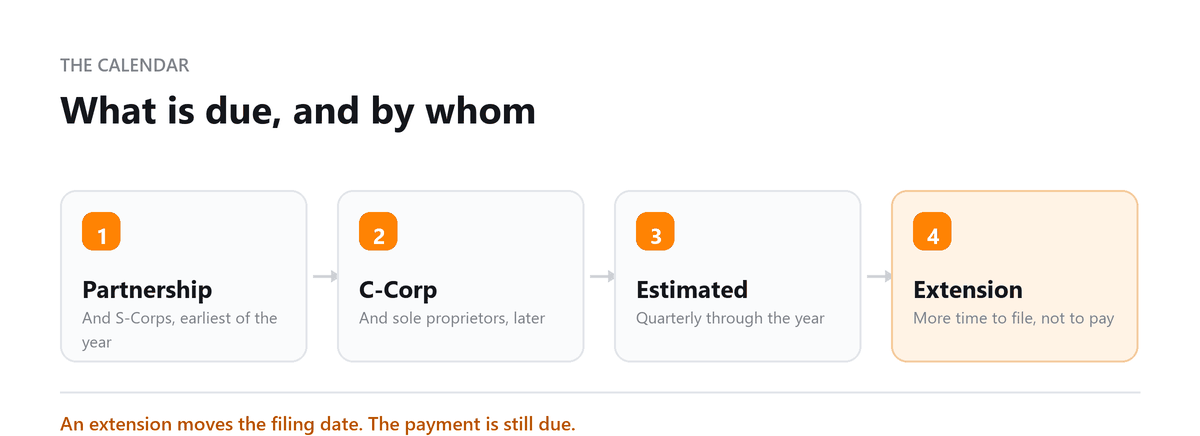
A filing extension extends your time to file, not your time to pay. If you owe tax, pay your best estimate by the original deadline to avoid failure-to-pay penalties and interest.
- Individuals: File Form 4868 by April 15 for a 6-month extension to October 15
- S-Corps / Partnerships: File Form 7004 by March 16 for a 6-month extension to September 15
- C-Corps: File Form 7004 by April 15 for a 6-month extension to October 15
Penalties for Missing Deadlines
| Penalty Type | Rate |
|---|---|
| Failure to file (income tax) | 5% of unpaid tax per month, max 25% |
| Failure to pay | 0.5% of unpaid tax per month, max 25% |
| Underpayment of estimated tax | Interest at current IRS rate |
| FUTA late deposit | 2% to 15% depending on how late |
How to Stay Organised Year-Round
Build a Tax Calendar
Add every federal, state, and payroll deadline that applies to your business, with reminders two to three weeks ahead. That's enough time to gather information and move money if needed.
Keep Your Books Current
Monthly bookkeeping lets you estimate quarterly taxes accurately and gives your accountant what they need well before filing deadlines.
Set Aside Money for Taxes
Move a set percentage of profit into a separate tax savings account each month. Many owners use 25 to 30 percent as a starting point, but the right figure depends on your tax bracket, state, and business structure.
Plan Ahead of the Busy Season
Run a tax projection in the fourth quarter and again before the first filing deadline. It shows what you'll owe, whether an extension payment is needed, and whether any year-end moves still make sense.
Automate What You Can
Payroll providers can handle deposits and payroll filings, and EFTPS lets you schedule federal tax payments in advance. Automation is one of the easiest ways to avoid deposit penalties.
Conclusion
Tax deadlines don't move for busy seasons, cash crunches, or missing paperwork. S corporations and partnerships start the filing year in March, individual and C corporation returns follow in April, estimated taxes are due four times a year, and payroll and information returns bring their own dates.
Know which ones apply to you, file on time or extend even when you can't pay in full, and build reminders and cash reserves into your routine. That's how you keep penalties and interest from quietly adding to your tax bill.
Book a free consultation and we will file everything on time.
Frequently Asked Questions
When are business tax returns due in 2026?
Partnership and S corporation returns for the 2025 tax year were due March 16, 2026. C corporation returns and individual returns, including sole proprietors, were due April 15, 2026. With an extension, those deadlines move to September 15 and October 15, 2026, respectively.
What happens if I miss a business tax filing deadline?
It depends on the return. For income tax returns with a balance due, the failure-to-file penalty is 5 percent of the unpaid tax per month, up to 25 percent. Late partnership and S corporation returns are penalized per owner, per month, even when no tax is owed. Interest and failure-to-pay penalties can apply on top of that, so file as soon as you can.
Can I get an extension on my business tax return?
Yes. Businesses file Form 7004, and individuals file Form 4868, by the original due date. The extension gives you six more months to file, but not more time to pay. Estimate what you owe and pay it by the original deadline to limit penalties and interest.
When are quarterly estimated taxes due for 2026?
Estimated payments for the 2026 tax year are due April 15, June 15, and September 15, 2026, and January 15, 2027. Each payment covers income earned in a specific period, and the periods aren't equal in length.
Are state tax deadlines the same as federal deadlines?
Often, but not always. Many states align their income tax due dates with the federal calendar, but some use different dates, and sales tax, payroll tax, and franchise tax deadlines are set entirely by each state. Check each state where you have filing obligations.

Written by
Ankit Sarawagi, CPA, CA, MBA
Ankit leads the finance team at Profitjets, where he has worked with 500+ businesses across the US on bookkeeping, tax and CFO-level strategy. He writes about the habits that keep small business books accurate all year. Connect on LinkedIn
Free consultation
Want the Dates Handled?
Book a free consultation and we will file everything on time.