
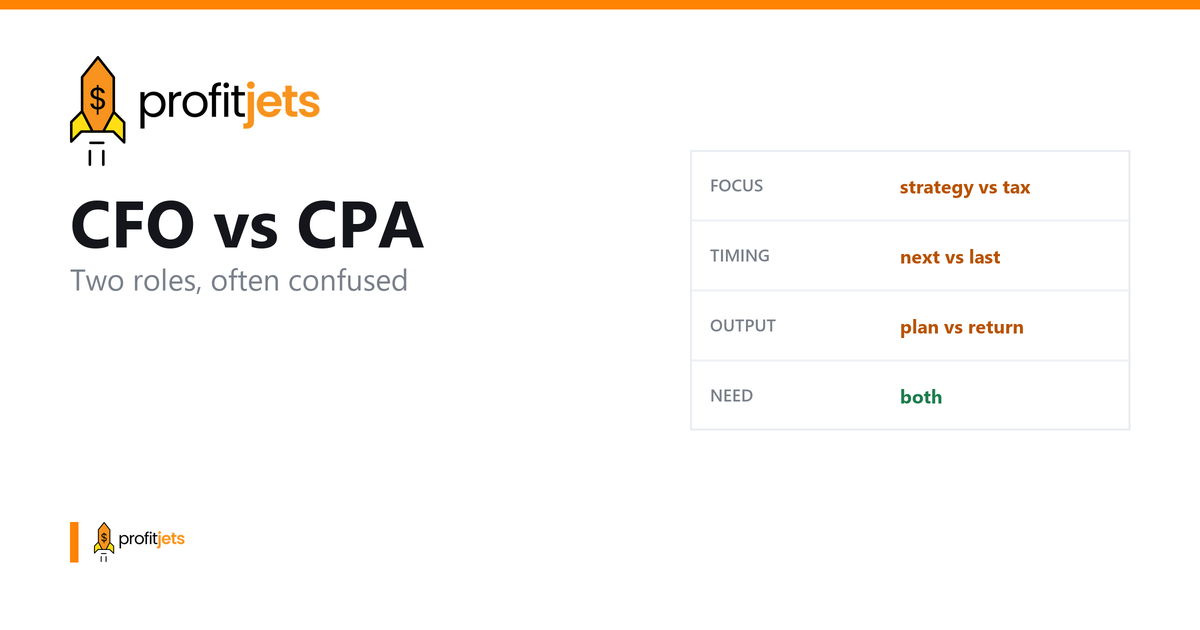
A lot of founders believe that their financial leadership needs are fully met due to having a good CPA. The taxes are filed timely, the books close on time every year, the accountant answers the phone, and responds promptly. Then there comes an investor who asks for a three-year model, a lender who requests covenant projections, or a big layoff/hiring decision that requires a detailed cash forecasting, and then it becomes apparent that it's all not someone's core responsibilities.
That's where the difference between a CPA and a CFO lies. A CPA is a certified accountant who makes sure that all financial statements are correct, and taxes are filed accordingly. CPA's job is retrospective, and they focus on ensuring that the information that's already there doesn't have any errors, is presented properly, and follows all tax and accounting standards.
A CFO, on the other hand, is an executive responsible for future-focused financial planning, making projections, and advising the company's management about optimal financing, liquidity management, and risk assessment.
Mixing CPA and CFO duties is extremely expensive both ways. Leaving strategic planning to a CPA means letting your business decisions be driven by guesswork. Whereas employing a CFO and letting them do your CPA duties is asking the person to do the work that the CPA firm should be doing. This guide breaks down what each role does, where they overlap, how they differ, and how to tell which one your business needs right now.
What is a CFO?
A Chief Financial Officer (CFO) is a senior executive responsible for the overall financial health of a business. The CFO manages financial strategy and planning, investor relations, capital structure, risk management, and financial reporting. The CFO reports to the CEO and, through the audit and finance committee, to the board of directors. The role is not a formal credential or qualification, it is a career-progression executive title earned through years of financial leadership experience.
A CFO's primary value is forward-looking: they help the business decide where to allocate capital, how to structure financing, whether to pursue an acquisition, and how to manage financial risk over the coming years. They translate the CEO's strategic ambitions into financial plans, and push back when the numbers don't support those ambitions.
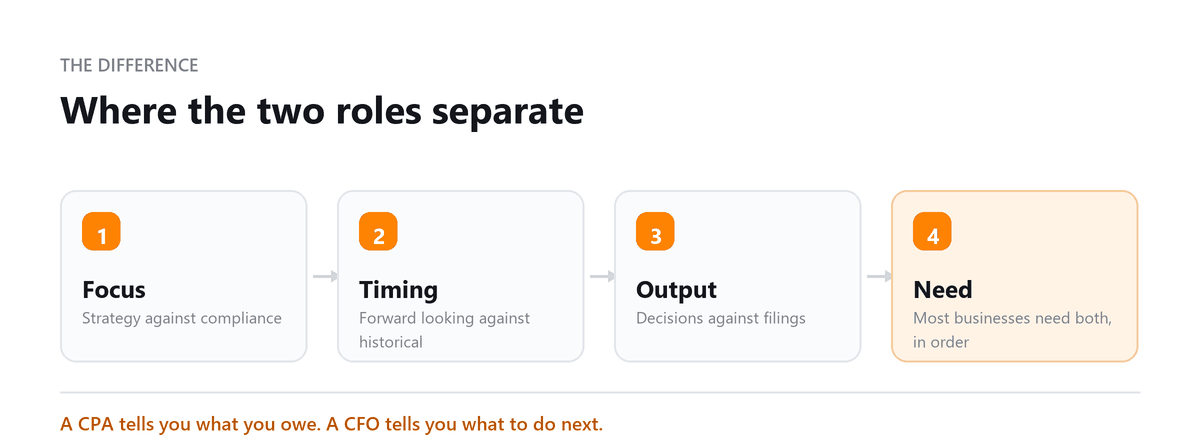
I see this confusion constantly: founders who think they've covered financial leadership by hiring a great CPA. A CPA tells you what happened. A CFO helps you decide what to do next. If you want the business to grow, you need both of those conversations happening.
Anu Gupta, CA, EA, B.Tech · LinkedInWhat is a CPA?
A Certified Public Accountant (CPA) is a licensed accounting professional who has passed the Uniform CPA Examination administered by the American Institute of CPAs (AICPA) and met state-specific education and experience requirements. The CPA license authorizes the holder to perform financial statement audits, sign audit opinions, prepare tax returns, provide tax advisory services, and represent clients before the IRS.
A CPA can work as an external professional (at an accounting firm, as an independent practitioner) or as an internal employee. Their primary value is technical and backward-looking: ensuring that what happened financially is accurately recorded, properly reported, and in compliance with applicable law and accounting standards.
CFO vs CPA: What Do They Do?
| Dimension | CFO | CPA |
|---|---|---|
| Primary focus | Financial strategy and leadership | Technical accounting and compliance |
| Role type | Executive employee (internal) | External professional or internal accountant |
| Scope | Entire financial function | Specific accounting/tax/audit work |
| Decision authority | Sets financial policy and strategy | Executes and certifies |
| Investor interaction | Regular (investor relations) | Periodic (audit, tax filing) |
| License required | No formal license | Yes, CPA license (state-specific) |
CFO vs CPA: Similarities
Both a CFO and a CPA require deep financial knowledge and work extensively with financial statements. Many CFOs hold the CPA credential, it is actually a common educational and early-career foundation for CFOs, particularly at companies where technical accounting credibility matters. Both roles are critical to organizational financial health, and both carry professional responsibilities that extend beyond their individual employers, the CPA through licensing obligations, the CFO through board and investor accountability.
CFO vs CPA: Key Differences
Scope is the most fundamental difference. A CFO's scope is the entire organization, they are responsible for the financial strategy, planning, and performance of the business as a whole. A CPA's scope is the specific technical task at hand: an audit engagement, a tax return, an accounting project. A CFO makes decisions; a CPA advises and certifies.
Authority separates the roles as well. A CFO is the decision-maker, they have authority to set financial policy, approve capital expenditures, negotiate financing, and present financial strategy to the board. A CPA is an advisor and certifier, they provide expert opinion and technical execution, but the decisions belong to management.
Education and credentials differ in important ways. A CPA credential requires passing a four-part licensing examination that tests technical accounting and auditing knowledge. A CFO role requires no specific license, it requires a career progression that typically includes 15 or more years of experience, often including a CPA and/or MBA, plus demonstrated financial leadership across multiple disciplines.
When Does Your Business Need a CPA?
A CPA is essential for: annual tax return preparation (particularly for businesses with complex tax situations, multi-state, international, or pass-through entity structures); financial statement audit or review required by lenders, investors, or regulators; tax planning to minimize the business's tax burden legally; accounting system setup and chart of accounts design; and IRS correspondence or audit representation. Businesses of virtually all sizes benefit from CPA services, the complexity of engagement scales with business size.
When Does Your Business Need a CFO?
A CFO becomes essential when the business needs financial strategy, not just financial recording. Specifically: when the business is planning to raise institutional capital (investors require sophisticated financial modeling and investor reporting that goes beyond tax returns); when financial complexity has grown beyond what a bookkeeper or accountant can manage (multiple entities, complex revenue structures, significant debt); when the business is contemplating M&A; or when managing a finance team requires executive leadership. Most businesses encounter this inflection point somewhere between $1 million and $5 million in annual revenue.
Can You Have Both?
Yes and most established businesses do. The CFO leads financial strategy and manages the overall finance function. The CPA (whether an external firm or an internal controller who holds the designation) ensures technical accounting accuracy and compliance. Many CFOs are CPAs themselves, holding both the executive role and the professional credential. In this structure, the CFO-CPA combination is most powerful: strategic leadership backed by technical credibility.
Profitjets CFO and Accounting Services
Profitjets works with growing US businesses on both halves of the finance function. On the compliance side, that means bookkeeping, tax preparation, and accounting support that keeps your records accurate and filings on time.
On the strategic side, fractional CFO services cover financial modeling, cash forecasting, investor reporting, and decision support. Having both under one roof means the people building your forecast are working from the same numbers as the people closing your books.
A CPA and a CFO aren't competing choices. They answer different questions. The CPA makes sure your past financial activity is accurate, compliant, and properly reported. The CFO uses that foundation to decide what the business should do next. Early on, a good CPA may be all you need. As the business grows, raises money, or takes on complexity, adding CFO-level leadership, fractional or full-time, is what turns clean numbers into better decisions.
Book a free consultation and we will tell you which one solves your problem.
Frequently Asked Questions
Is a CPA better than a CFO?
Neither is better, because they do different jobs. A CPA handles technical accounting, tax, and audit work. A CFO provides financial leadership and strategy. Most growing businesses need a CPA for compliance and a CFO, in-house or fractional, for planning and major decisions.
Can a CPA become a CFO?
Yes, and it's a very common path. The CPA license is especially valued in public companies, financial services, and healthcare, where technical accounting credibility matters. The typical progression runs from CPA to controller to VP Finance to CFO over roughly 15 to 20 years.
Does a startup need a CPA or a CFO first?
Most early-stage startups need a CPA first, for entity setup, tax compliance, and basic financial statements. As revenue grows, often somewhere between $500K and $2M, a fractional CFO becomes worthwhile for modeling, investor reporting, and planning. By Series A, both are usually essential.
What can a CPA do that a CFO can't?
Only a licensed CPA can perform an audit and sign an audit opinion on financial statements. CPAs can also represent clients before the IRS in tax disputes. A CFO who doesn't hold a CPA license can't do either of those things.
What's the difference between a CFO and a controller?
A controller, who is often a CPA, runs the accounting function: accurate books, financial statements, internal controls, and the accounting team. A CFO sits above the controller and handles financial strategy, investor and board relationships, treasury, capital allocation, and advising the CEO on major decisions.

Written by
Anu Gupta, CA, EA, B.Tech
Anu works with US businesses on tax and entity questions at Profitjets, from choosing a structure to the filings that follow it. She writes about the decisions owners make once and then live with for years. Connect on LinkedIn
Free consultation
Not Sure Which You Need?
Book a free consultation and we will tell you which one solves your problem.