

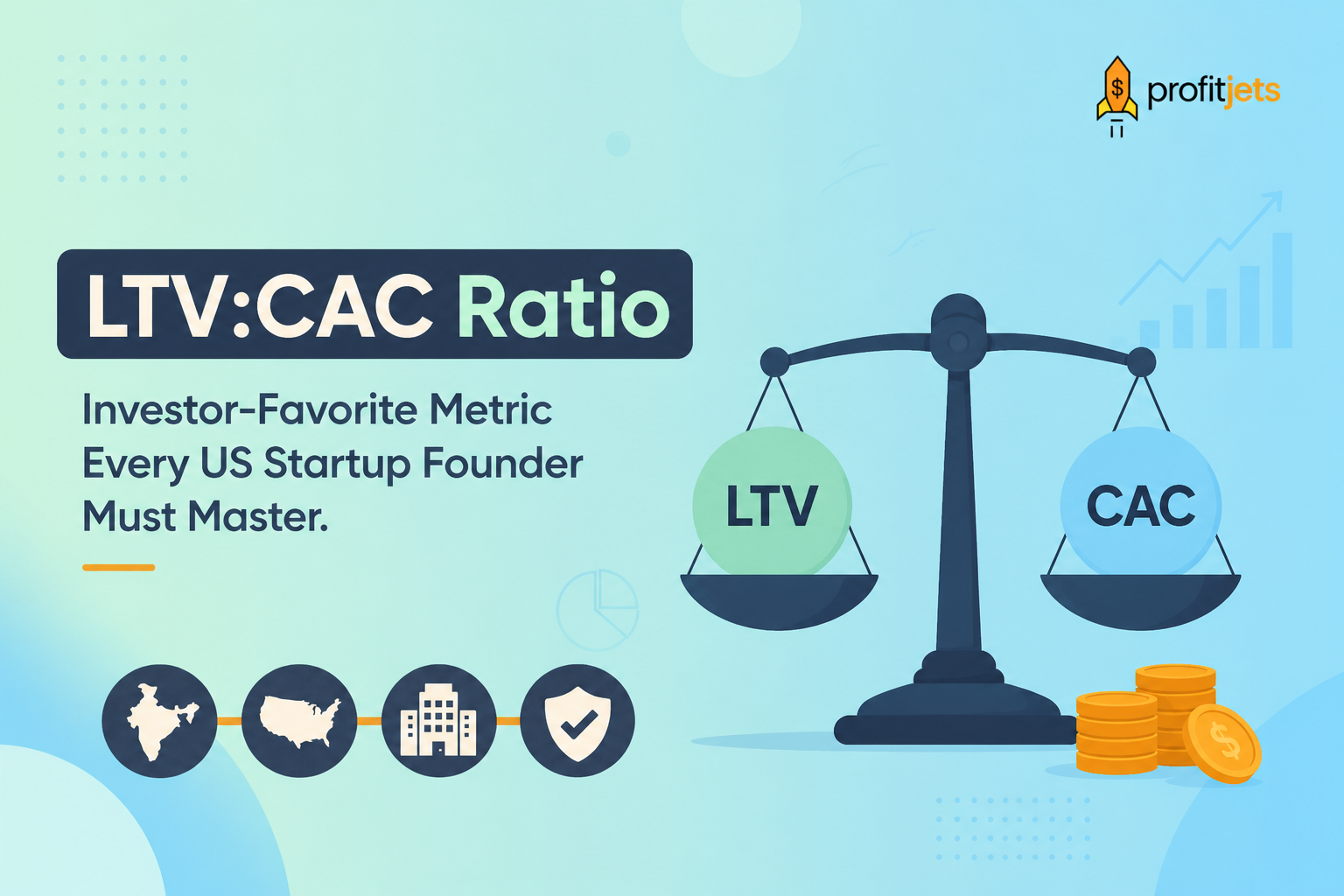
The LTV:CAC (Lifetime Value to Customer Acquisition Cost) ratio is one of the most important metrics for understanding whether your business is truly growing or just spending. You can keep investing in customer acquisition, but if you don’t know how much each customer is worth over time, you’re operating without a clear path to sustainable growth. That’s exactly what the LTV:CAC ratio helps you measure.
For startups, SaaS companies, and e-commerce brands, this ratio is a key indicator of unit economics and one of the first numbers investors look at. Despite its importance, many businesses either don’t track it properly or rely on inaccurate calculations, leading to misleading insights.
Your LTV:CAC Ratio is calculated by the formula,
LTV:CAC Ratio = Customer Lifetime Value ÷ Customer Acquisition Cost
The LTV:CAC ratio measures how much value a customer generates compared to what it costs to acquire them. A higher ratio indicates stronger unit economics and more efficient growth. Most businesses aim for a benchmark of 3:1, meaning every ₹1 spent on acquisition returns ₹3 in lifetime value.

According to the Internal Revenue Service, businesses should maintain accurate records of income and deductible expenses to ensure reliable financial reporting and tax compliance. In this guide, you’ll learn what the LTV:CAC ratio means, how to calculate it correctly, what a strong ratio looks like, and practical ways to improve it
What the LTV:CAC Ratio Actually Measures
The LTV:CAC ratio compares the Lifetime Value (LTV) of a customer to the Customer Acquisition Cost (CAC). In simple terms, it tells you how much revenue you earn from a customer over their entire relationship with your business versus how much you spent to win them in the first place.
- LTV (Customer Lifetime Value) = the total net revenue a customer generates from the day they sign up until they stop buying from you.
- CAC (Customer Acquisition Cost) = the total cost of sales, marketing, and related expenses divided by the number of new customers acquired in a given period
Together, they answer the question every investor is implicitly asking when they look at your growth metrics:
For every dollar this company spends acquiring a customer, how many dollars does it get back and how long does it take?
A ratio 3:1 means the business generates three dollars in lifetime gross profit for every dollar spent on acquisition. That is the widely accepted minimum threshold for a sustainable, investable growth model. Below it, you are subsidizing growth. Above it, you have the room to scale.
How to Calculate the LTV:CAC Ratio: Step by Step
Step 1: Calculate your Customer Lifetime Value (LTV)
The most common LTV formula for subscription and recurring-revenue businesses is:
LTV = Average Revenue Per User (ARPU) × Gross Margin % × Average Customer Lifespan
Let us use a real example. Say you run a software company:
- Average monthly subscription: $200
- Gross margin: 70%
- Average customer stays for: 24 months
LTV = $200 × 70% × 24 = $3,360
For non-subscription businesses: retail, e-commerce, professional services, use purchase frequency and average order value instead:
LTV = Average Order Value × Purchase Frequency Per Year × Average Customer Lifespan (years) × Gross Margin %
Accurate lifetime value calculations depend entirely on clean, up-to-date financial records. If your books are not reconciled regularly, your ARPU and gross margin figures will be off, and so will your lifetime value. Professional bookkeeping services ensure the underlying data you feed into these calculations is reliable.
Step 2: Calculate your Customer Acquisition Cost (CAC)
Your Customer Acquisition Cost is calculated by the CAC formula as follows:
CAC = Total Sales & Marketing Spend ÷ Number of New Customers Acquired
Using the same company:
- Total marketing spend in Q1: $50,000
- Sales team salaries (Q1): $30,000
- Tools, ads, events: $20,000
- Total spend: $100,000
- New customers acquired in Q1: 100
CAC = $100,000 ÷ 100 = $1,000
Step 3: Divide LTV by CAC
LTV:CAC = $3,360 ÷ $1,000 = 3.36:1
That is a solid ratio for every dollar spent on acquisition, this business generates $3.36 in lifetime value.
What Is a Good LTV:CAC Ratio for Growing Businesses
There’s no fixed benchmark, but most investors use a few commonly accepted ranges across industries:There is no single universal answer, but here are widely accepted benchmarks across industries:
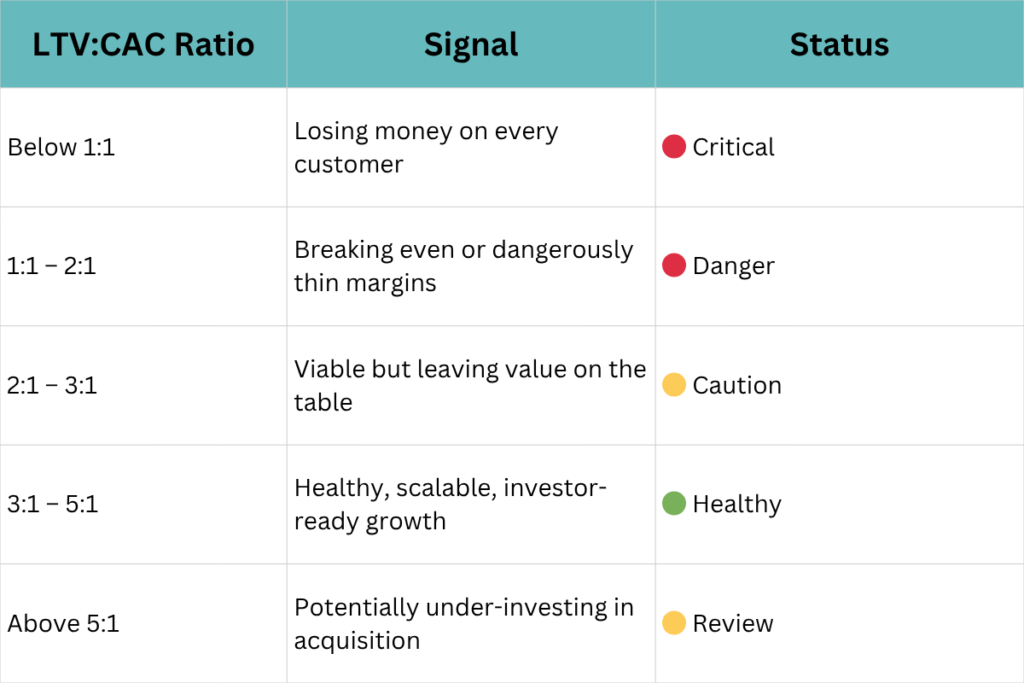
The 3:1 benchmark became the standard largely through SaaS industry research and is now applied broadly. However, context always matters. A capital-intensive business or one with long sales cycles may operate healthily at 2.5:1, while a high-velocity e-commerce brand should aim for 4:1 or higher.
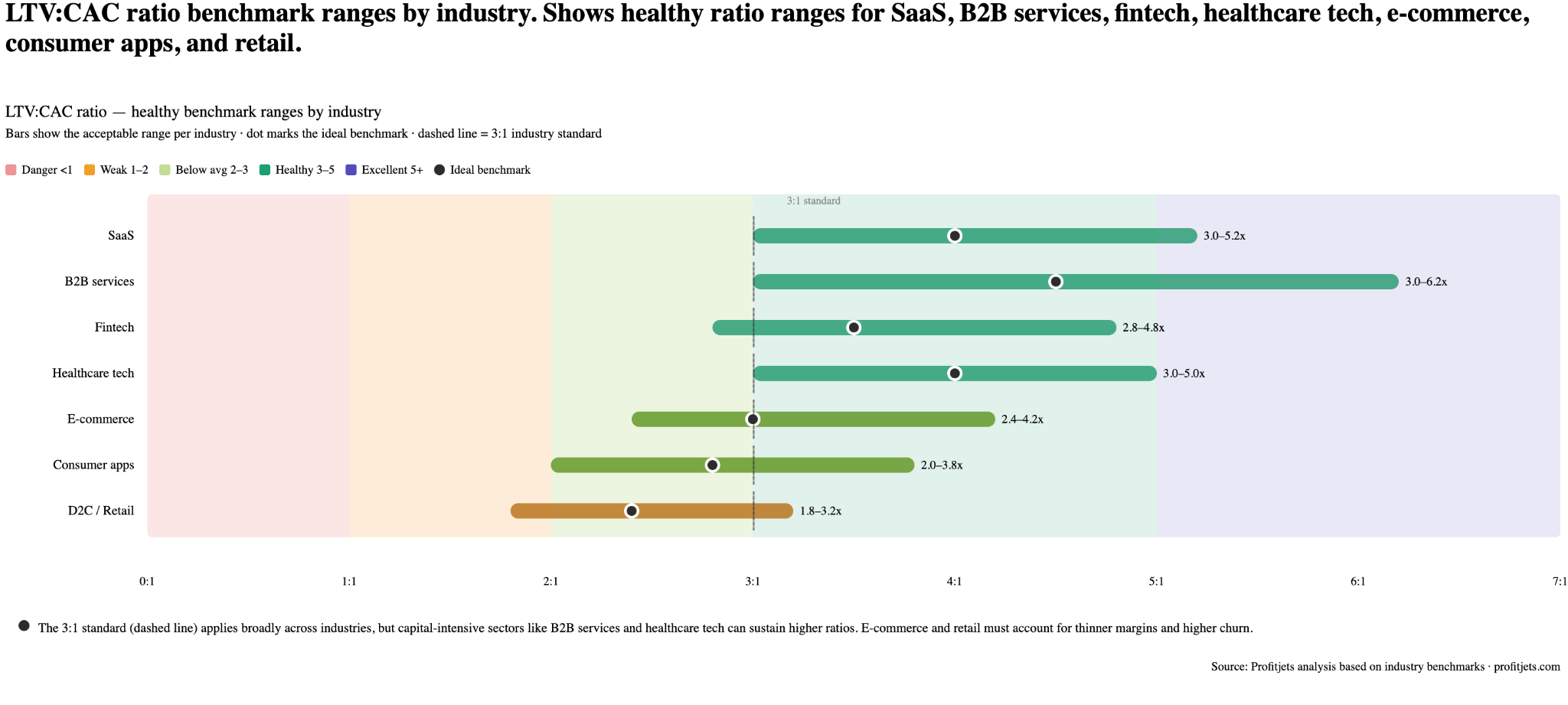
For e-commerce businesses, where customer churn is higher and margins thinner, tracking LTV:CAC at the SKU or customer segment level gives far more actionable insight than a company-wide average.
Why the LTV:CAC Ratio Matters So Much
1. The clearest measure of business sustainability
Revenue growth alone does not tell you whether a business is healthy. A company can grow 100% year-on-year and still be heading toward collapse if it costs more to acquire customers than those customers ever return. The LTV:CAC ratio cuts through vanity metrics and shows the true unit economics of your growth engine.
2. Investors treat it as a non-negotiable metric
If you are raising capital, at any stage, investors will examine your LTV:CAC ratio closely.
A ratio below 1:1 is a red flag. A ratio above 3:1 suggests strong product-market fit and efficient go-to-market strategy.
For SaaS companies especially, investors use this number to project scalability.
3. Guides where to invest and where to cut
When you know your LTV:CAC by acquisition channel, customer segment, or product line, you can make sharper decisions. If customers acquired through organic search have a 5:1 ratio while those from paid social deliver 1.5:1, you know exactly where to redirect budget.
What Investors Are Actually Asking When They Ask About LTV:CAC
Experienced investors rarely ask about the LTV:CAC ratio because they are interested in the number itself. They ask because the answer reveals the quality of the founder’s thinking about their own business.
When a founder can walk through their LTV:CAC calculation explain which formula they used for LTV, why they chose it, how they define CAC (fully loaded or not), how the ratio varies by segment, and what specific initiatives are moving it, that conversation builds conviction. It demonstrates that the founder is running the business on real unit economics, not projections that feel good in a slide.
When a founder cannot answer cleanly or presents a number without being able to explain the assumptions behind it, that gap is noted. In a competitive fundraising environment, it is often disqualifying at later stages regardless of the headline growth metrics.
The CAC Payback Period: How Fast Are You Getting Your Money Back
Your CAC Payback Period is the number of months it takes to recover what you spent acquiring a customer. It is a critical cash flow metric, especially for businesses burning capital on growth.
CAC Payback Period = CAC ÷ (Monthly Revenue per Customer × Gross Margin %)
This means the business recoups its acquisition cost within roughly 7 months. Anything under 12 months is generally considered healthy.
Shortening payback does not always mean cutting acquisition spend. Often, improving onboarding to accelerate early expansion revenue is faster, cheaper, and more immediately effective than reducing your marketing.
Understanding your payback period alongside your LTV:CAC ratio is also critical for working capital planning. If you are growing fast but your payback period is 18 months, you need sufficient cash reserves to fund that gap. See our guide on working capital management for how to plan around this.
Ways to Improve Your LTV:CAC Ratio in 2026
You can improve this ratio from either side of the equation, increasing LTV, decreasing CAC, or both simultaneously.
1.Improve customer retention and reduce churn
The single most powerful lever on LTV is how long customers stay. Focus on onboarding quality, customer success touchpoints, and proactive support.
2. Expand revenue per customer
Upsells, cross-sells, and tiered pricing all raise ARPU without adding acquisition cost. If you offer multiple service tiers guiding customers to the right tier early in the relationship directly lifts LTV.
3. Improve gross margin
Streamlining operations, re-negotiating supplier costs, and automating repetitive financial tasks all protect margin. Accurate financial reporting through regular bookkeeping is essential to spotting where margin is leaking.
4. Invest in organic and content channels
Channels that answers your buyers’ real questions, like what compounds over time in a way that paid ads cannot.
5. Shorten the sales cycle
Every day a prospect sits in your pipeline costs money. Clearer pricing pages, faster follow-up, and better qualification processes reduce the cost per close.
6. Double down on your highest-performing acquisition channels
Calculate LTV:CAC by channel rather than in aggregate. You may discover that referrals produce a 6:1 ratio while a trade show you attend annually yields 1.2:1. Reallocating that trade show budget changes your blended ratio significantly.
Why Founders Work with Profitjets for Financial Clarity
Most businesses that get their LTV:CAC ratio wrong aren’t making math errors. They’re working from books that haven’t been reconciled, cost allocations that exclude sales salaries, or LTV figures built on revenue instead of gross margin.
At Profitjets, we work with SaaS founders and growth-stage businesses to build the financial foundation that makes these numbers trustworthy not just presentable.
When your LTV:CAC ratio is grounded in accurate data, it stops being a slide deck number and starts being a decision-making tool that tells you where to invest, where to pull back, and how to walk into a fundraising conversation with genuine conviction.

Frequently Asked Questions (FAQs)
What is a good LTV:CAC ratio for startups?
A healthy LTV: CAC ratio is around 3:1, meaning you earn three times what you spend to acquire a customer. Below 2:1 signals weak unit economics, while above 5:1 may indicate underinvestment in growth.
Investors prefer a balance between efficiency and scalability. Consistency across cohorts matters more than a one-time strong number.
How do you calculate the LTV:CAC ratio accurately?
Divide Customer Lifetime Value (LTV) by Customer Acquisition Cost (CAC).LTV should factor in gross margin, retention, and revenue per customer.CAC must include all acquisition costs: marketing, sales salaries, tools, and onboarding.
Accurate inputs matter more than the formula itself.
Why is my LTV:CAC ratio low?
A low ratio usually points to high CAC or weak LTV. Common causes include poor retention, high churn, or inefficient marketing channels.
It may also result from long sales cycles or low pricing power. Fixing the root cause requires targeted improvements, not broad cost-cutting.
How can I improve my LTV:CAC ratio?
Increase LTV by improving retention, pricing, and customer expansion. Reduce CAC by optimizing channels, improving conversion rates, and shortening sales cycles.
Focus on high-quality customer acquisition, not just volume. And, sustainable improvement comes from balancing both sides of the equation.
How often should I track LTV:CAC?
You should track LTV:CAC monthly with cohort-level analysis. Regular tracking helps identify trends in acquisition efficiency and retention.It also allows faster decision-making and course correction. Waiting too long can hide problems until they become expensive.