
Reading lists for finance leaders tend to be long, aspirational and unfinished.
The ones that change anything are read against a live problem rather than in order, and produce one practice that survives into the following month. That is a more useful test than how many were completed.
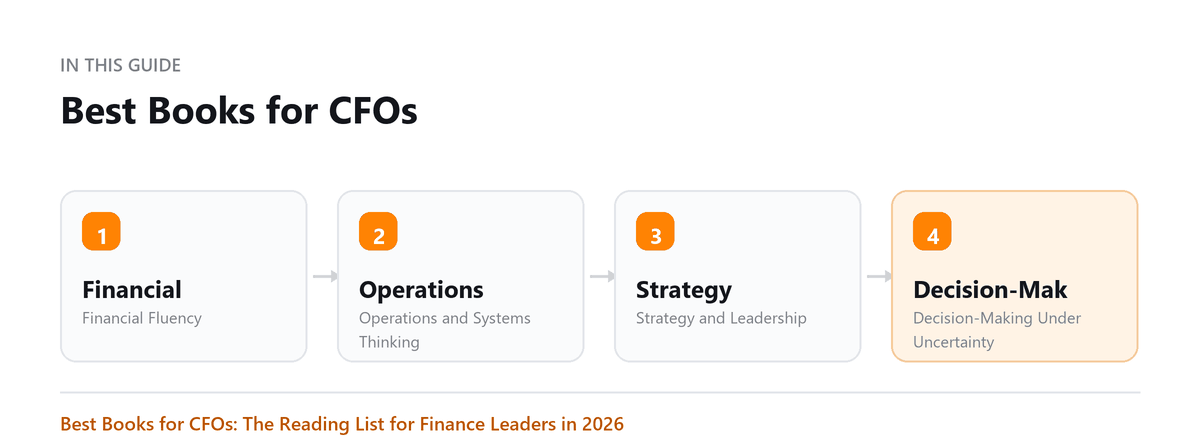
This is a shorter list organised by what you might currently be stuck on: financial fluency, operations, strategy, decision-making under uncertainty, and running the function itself.
The best CFOs are not just technicians who close the books. They are business partners, communicators, and strategic operators. This reading list covers the books that develop all three capabilities, from financial fluency to strategic thinking to decision-making under uncertainty.
Financial Fluency
Financial Intelligence, Karen Berman and Joe Knight
The best book for any CFO who needs to explain financial concepts to non-finance executives. Covers how the income statement, balance sheet, and cash flow statement connect, and how to use them to run a business. Required reading for finance leaders who present to boards and operating teams.
Corporate Finance, Brealey, Myers, and Allen
The standard academic text on corporate finance theory. Covers capital structure, cost of capital, valuation, options theory, and M&A. Dense but comprehensive. Keep it as a reference if not a cover-to-cover read.
Read against a problem rather than in order. Pick the one that speaks to something you are currently stuck on, read it while the problem is live, and take one practice into next month's work. A book applied once outlasts five skimmed.
Abhinav Gupta, CPA, CA, MBA · LinkedInOperations and Systems Thinking
The Goal, Eliyahu Goldratt
A novel about a manufacturing plant that illustrates the Theory of Constraints. Every CFO should understand throughput economics: the idea that the bottleneck in a system limits total output, and that optimizing non-constraints is waste. Applies directly to scaling a business.
The Lean CFO, Nicholas Katko
Applies lean manufacturing principles to the finance function. Argues that traditional standard costing and variance analysis drives the wrong behaviors. Relevant for CFOs in manufacturing, distribution, and operations-heavy businesses.
Strategy and Leadership
Principles, Ray Dalio
Dalio's framework for radical transparency, decision-making, and organizational design. Finance leaders who run planning processes, performance reviews, and compensation decisions will find specific tools here.
Good to Great, Jim Collins
Collins' research on what separates good companies from great ones. The Hedgehog Concept (what you can be best in the world at, what drives your economic engine, and what you are passionate about) is a direct input to strategic planning processes that CFOs facilitate.
Decision-Making Under Uncertainty
Thinking in Bets, Annie Duke
Former professional poker player's framework for making decisions when you cannot know the outcome in advance. Directly applicable to capital allocation, scenario planning, and how CFOs communicate probabilistic financial forecasts to boards.
Superforecasting, Philip Tetlock and Dan Gardner
Research on what makes some forecasters dramatically more accurate than others. Key insight: the best forecasters update their estimates frequently based on new information rather than anchoring to initial views. Applies to FP&A and rolling forecast design.
Finance Function Leadership
The AFP FP&A Guide Series
The Association for Financial Professionals publishes practice guides on driver-based planning, rolling forecasts, and scenario modeling. These are practitioner resources, not theory, and are updated regularly.
HBR Finance and Accounting Articles
Harvard Business Review's archive contains hundreds of practitioner-focused finance articles. Key topics: working capital management, incentive design, financial reporting and governance, and CFO-CEO relationship dynamics.
Book a free consultation and we will put senior eyes on your numbers.
Frequently Asked Questions
What should a new CFO read first?
Financial Intelligence (Berman and Knight) for communication skills and The Goal (Goldratt) for systems thinking. Then Thinking in Bets (Duke) for decision-making. These three build the foundation for most of what a CFO does day-to-day.
Are there good podcasts or resources beyond books?
CFO Thought Leader (Jack Sweeney), Acquired (Ben and David on business history), and the AFP Conversations podcast are strong. For technical content, the AICPA and FASB publish free educational materials on new accounting standards.
How much time should a CFO spend on professional development?
CPAs are required to complete 40 hours of CPE per year to maintain licensure. Beyond compliance, high-performing CFOs typically read 1-2 books per month and follow 3-5 industry publications. Allocate it like any other investment in your highest-leverage resource: yourself.
How should a busy finance lead actually get through a list like this?
Slowly, and against a problem. Reading in order, cover to cover, is how lists like this go unfinished. Pick the one that speaks to something you are currently stuck on, read it while the problem is live, and take one practice from it into the next month's work. A book applied once is worth more than five skimmed, and the applied one is the one you will still remember two years later.
Is reading a substitute for formal study or a qualification?
No, and it is not competing with one. A qualification establishes a baseline and is usually what a role or a regulator requires. Reading is how you keep current and how you borrow judgement from people who have faced situations you have not yet. The two do different jobs, and the reading tends to matter more the further into a career you get, when the questions stop having textbook answers.

Written by
Abhinav Gupta, CPA, CA, MBA
Abhinav works with business owners across the US on industry-specific bookkeeping, from dental practices and restaurants to construction and e-commerce. He writes about what each trade's books actually need. Connect on LinkedIn
Related articles
Free consultation
Want CFO-Level Clarity?
Book a free consultation and we will put senior eyes on your numbers.