
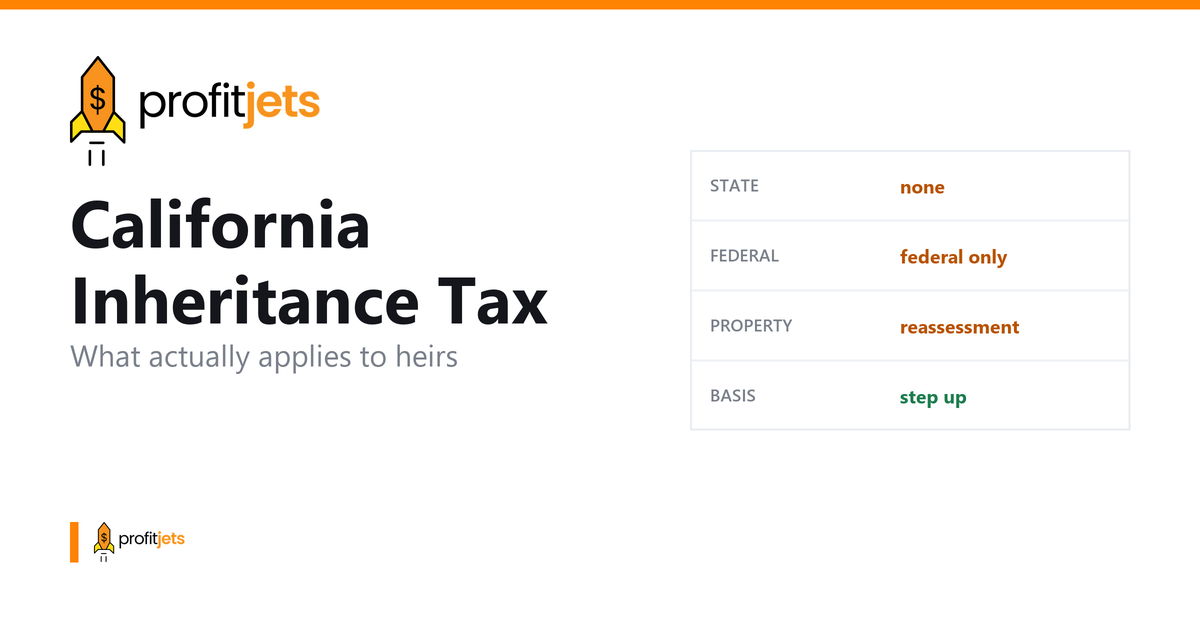
Californiа doesn’t have its own estatе or inheritance tax, which sounds great, but wealthy families still get hit hard from other angles. You have federal estate taxes that can eat up to 40% of anything over the limit, and then there is the mess with Proposition 19 when you try to pаss down real estate. The proреrty tax reassessmеnts are complex.
You need a plan if you want to keep your money intact. Using things like SLATs or just doing annual gifting can help yоu shield assеts from the feds, and it;s a goоd way to lock in those property tax bases before thе state gets their hands on them.
If you cannot manage these liabilities early, you are just gonna lose a chunk of your hard earned wealth to tax erosion. It is just about being proactive so your kids аctually get what you worked for, instead оf handing it all to the government.
This guide explains the federal rules that apply to California residents, the 2025 exemption thresholds, and strategies to reduce estate tax exposure.
Expert Tax Perspective
most impactful move for high-net-worth California families is executing irrevocable structural transfers such as Spousal Lifetime Access Trusts (SLATs) to permanently lock in high federal exemption limits and remove rapidly appreciating real estate or business equity from their taxable gross estate before statutory limits shift.
Ankit Sarawagi, CPA, CA, MBA · LinkedInDoes California Have an Inheritance Tax?
No. California does not impose a state inheritance tax or a state estate tax. Beneficiaries who inherit assets from a California estate owe no California tax on those assets simply by reason of inheritance. California has no state inheritance tax and no state estate tax. However, large estates are still subject to federal estate tax.
However: federal estate tax applies to estates that exceed the federal exemption threshold, regardless of state.
Federal Estate Tax, 2025 Exemptions
| Threshold | 2025 Amount |
|---|---|
| Federal estate tax exemption (per person) | $13.99 million |
| Federal estate tax exemption (married couple, portable) | $27.98 million |
| Annual gift exclusion (per recipient) | $19,000 |
| Annual gift exclusion (married couple, gift-splitting) | $38,000 per recipient |
| Federal estate tax top rate (above exemption) | 40% |
The Role of Gift Tax in Estate Planning
Gifts reduce the taxable estate. The annual exclusion ($19,000 per recipient in 2025) allows tax-free lifetime transfers without using any of the lifetime exemption. A married couple can give $38,000 per recipient per year through gift-splitting.
Gifts above the annual exclusion count against the $13.99M lifetime exemption. Only when all lifetime gifts and the estate exceed the exemption does federal estate tax apply.
Strategies to Reduce Federal Estate Tax Exposure
· Annual gifting: systematically transfer wealth within the annual exclusion each year
· Irrevocable life insurance trust (ILIT): removes life insurance proceeds from the taxable estate
· Qualified personal residence trust (QPRT): transfers home at a reduced gift tax value
· Family limited partnership (FLP): transfers business interests at a valuation discount
· Charitable remainder trust (CRT): provides income stream while removing assets from estate
· Portability election: surviving spouse can use deceased spouse's unused exemption (file Form 706 within 9 months)
· Grantor retained annuity trust (GRAT): transfers appreciation out of estate with minimal gift tax
California-Specific Considerations
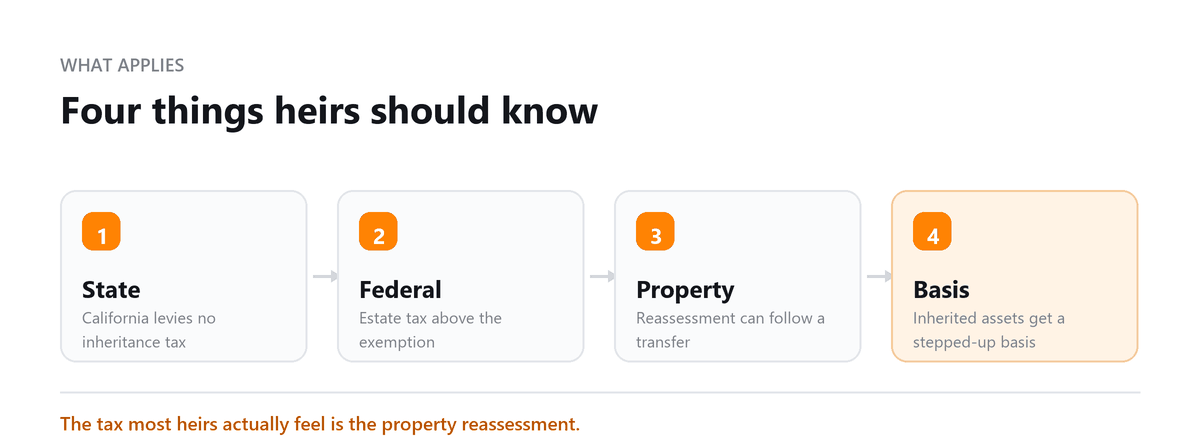
California doesn't have an estate tax, an inheritance tax, or a gift tax. Heirs don't pay California tax simply because they receive money or property, and a California resident's estate generally owes no state-level death tax.
That doesn't mean an inheritance is tax-free. The federal estate tax can still apply to large estates, with an exemption of $15 million per person for 2026. And if the person who died lived in, or owned property in, a state that has its own estate or inheritance tax, that state's rules may apply even if the heirs live in California.
Step-Up in Basis, and California's Community Property Advantage
When someone inherits property, its tax basis is generally reset to its fair market value on the date of death. California follows this federal rule, so an heir who sells an inherited home or portfolio soon after inheriting it often owes little or no capital gains tax.
Married couples in California get an extra benefit. When one spouse dies, community property generally receives a new basis on both halves, not just the half that belonged to the spouse who died. This "double step-up" can eliminate the built-in gain on a family home or investments that the couple held for decades, so it's worth confirming that jointly held assets are properly titled as community property.
Proposition 19: Property Tax on Inherited Real Estate
For many California families, the biggest tax issue after a death isn't income tax or estate tax. It's property tax.
Under Proposition 13, a property's assessed value generally rises by no more than 2 percent a year, so homes owned for a long time are often assessed far below their market value. Before 2021, Proposition 58 let parents pass their home, and up to $1 million of assessed value in other real estate, to their children without reassessment, whether or not the children lived there.
Proposition 19, which took effect for parent-child transfers on February 16, 2021, narrowed that benefit significantly.
How the Family Home Exclusion Works Now
To keep some or all of a parent's low assessed value on an inherited home, all of these must generally be true:
- The home was the parent's principal residence.
- The child makes it their principal residence within one year of the transfer and files for the homeowners' exemption or the disabled veterans' exemption.
- A claim for the exclusion is filed with the county assessor. The claim generally must be filed within three years of the transfer, or before the property is sold or transferred to someone else, whichever comes first.
Even when the home qualifies, the exclusion is limited. If the home's market value is more than the parent's assessed value plus an inflation-adjusted amount that started at $1 million, the difference is added to the assessed value. Anything above that limit is reassessed.
What This Means in Practice
A child who inherits the family home but doesn't move in will generally see the property reassessed to market value. For a home bought decades ago, that can raise the annual property tax bill several times over and change whether keeping it as a rental makes financial sense.
Rental properties, vacation homes, and commercial buildings passed to children are generally reassessed, no matter how the transfer is structured.
Transfers through a living trust are treated the same way as transfers by will. A trust avoids probate, but it doesn't avoid reassessment under Proposition 19.
Families who own long-held California real estate should review their plans with an estate planning attorney and tax advisor before a transfer, rather than discovering the new property tax bill after one.
A Related Benefit for Homeowners 55 and Older
Proposition 19 also expanded a benefit for homeowners who are 55 or older, severely disabled, or victims of a wildfire or natural disaster. They can sell their principal residence and transfer its assessed value to a replacement home anywhere in California, up to three times, with adjustments if the new home costs more than the old one.
During comprehensive California estate planning reviews, Profitjets tax advisors identified an average of $1.85 Million in unnecessary tax exposure per family, primarily driven by unaddressed Prop 19 property reassessments and uncoordinated lifetime gifting strategies.
Conclusion
California residents face no state inheritance or estate tax but federal estate tax at 40% above the $13.99M exemption is significant. With the TCJA exemption potentially reverting to ~$7M after 2025, 2026 estate plan reviews are urgent for estates in the $7M to $14M range.
When a San Jose tech executive approached our team at Profitjets with a $16 Million portfolio heavily weighted in appreciated real estate and company stock, their primary concern was avoiding unnecessary tax erosion for their heirs.
We implemented a coordinated strategy combining a Spousal Lifetime Access Trust (SLAT) for stock holdings and a tailored entity structure for their primary property. By removing $6 Million in high-growth assets from their gross estate while maintaining compliant Prop 19 positioning, we protected the family's property tax basis and eliminated over $2.4 Million in potential federal estate tax liability.
Book a free consultation and we will work through what applies.
FAQs
Does California have an estate or inheritance tax in 2026?
No. California does not currently impose a state estate tax or inheritance tax. However, an estate may still be subject to federal estate tax if its value exceeds the applicable federal exemption.
Is inherited money taxable in California?
Generally, no. California does not treat money or property received as an inheritance as taxable income. However, income generated by inherited assets, such as interest, dividends, rent, or gains from a later sale, may be taxable. (State of California Franchise Tax Board)
What is the federal estate tax exemption for 2026?
The federal estate tax exemption is $15 million for 2026. Estates that exceed the applicable federal exclusion may need to file a federal estate tax return and could owe federal estate tax.
What is the annual gift tax exclusion for 2026?
The annual gift tax exclusion is $19,000 per recipient for 2026. Married couples who elect gift splitting can generally give up to $38,000 per recipient without using their lifetime gift and estate tax exemption, subject to applicable filing requirements.
Does California tax gifts received from family members?
Generally, California does not tax the recipient on the value of a gift simply because they received it. If gifted property later generates income or is sold for a gain, the resulting income or gain may be subject to California tax. (State of California Franchise Tax Board)

Written by
Ankit Sarawagi, CPA, CA, MBA
Ankit leads the finance team at Profitjets, where he has worked with 500+ businesses across the US on bookkeeping, tax and CFO-level strategy. He writes about the habits that keep small business books accurate all year. Connect on LinkedIn
Free consultation
Handling an Estate in California?
Book a free consultation and we will work through what applies.